
1. Internet for Everyone
Back to topa) A matter of rights and dignity
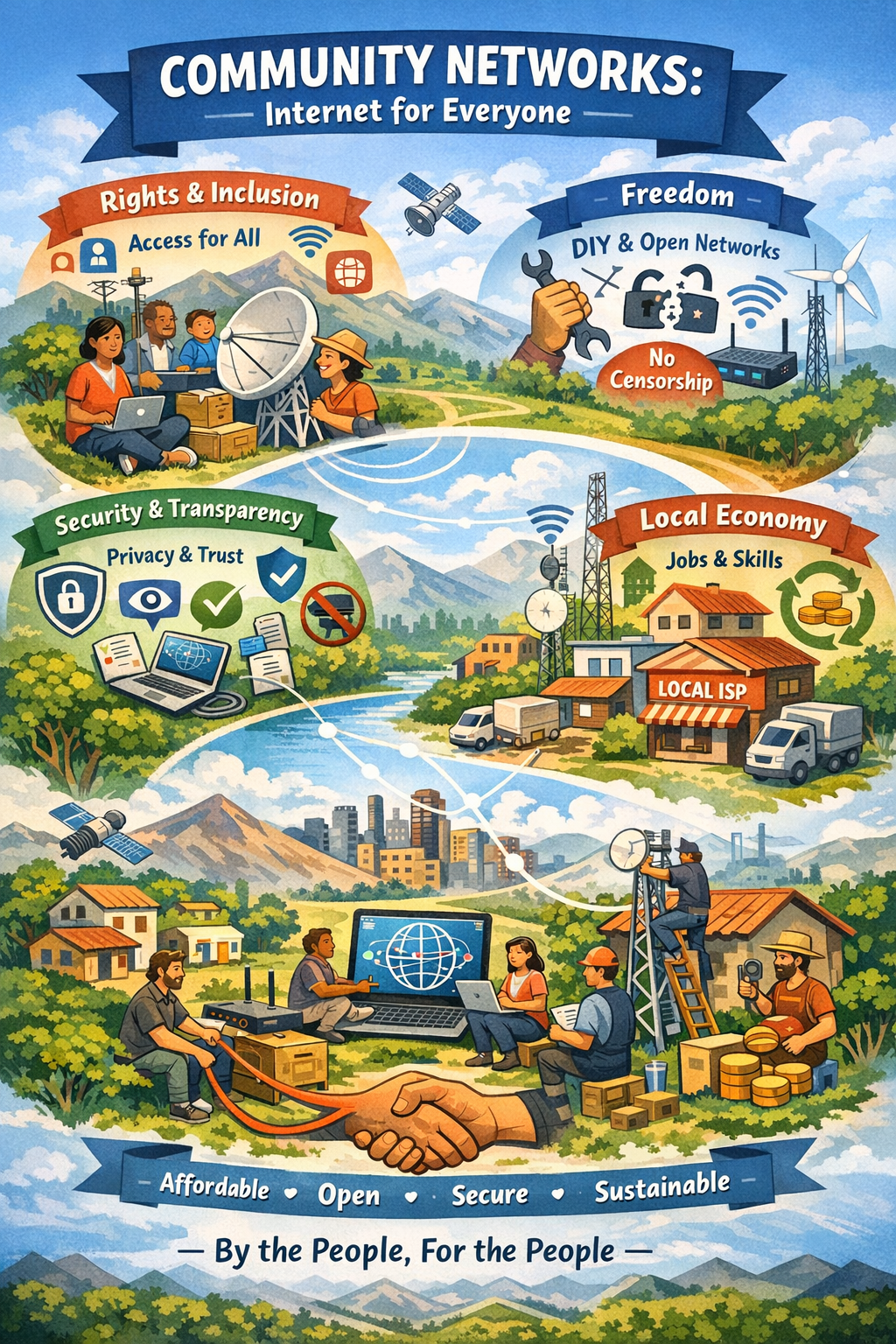
- Internet access enables the exercise of fundamental rights: freedom of expression, access to information, education, work, and participation in public life.
- The UN Human Rights Council has recognized the importance of internet access and has condemned intentional disruptions and restrictions (e.g., Resolutions 20/8 (2012), 26/13 (2014), 47/9 (2021)).
- Connectivity should also serve people and the community interest, not only to commercial interests.
b) Affordable and inclusive access
- Community networks help reduce costs through shared infrastructure and shared access.
- Go where is needed. Expand coverage to places the market often ignores (rural areas, low-income neighborhoods, remote communities).
- Inclusive by default (community governance, local onboarding, local-language support, accessible pricing).
c) Participation and community-building
- Acting collectively increases impact: skills, resilience, bargaining power, and long-term sustainability.
- Create local capacity: people learn, operate, maintain, and improve the network together.
2. Freedom
Back to topa) Internet as a “network of networks” — at every layer
- Internet openness and neutrality up to the edge, reaching even the final access network that connects people or things to the Internet.
- Self-service / DIY and shared access should remain a real option, not something blocked by incumbents, policy, regulations or commercial interests.
b) Technological sovereignty
- Be able to choose technologies and providers, have options to avoid lock-in, and control critical infrastructure that affects daily life.
- Learn, build, and protect
- Internet access should not be a “buy-only” product. People should be able to understand how it works, participate in building it, and help protect it.
- This strengthens autonomy, security awareness, and local problem-solving.
- No censorship and no arbitrary control
- Community networks can help reduce dependence on single gatekeepers and support open, neutral access policies.
- Privacy and security by design: local accountability, transparent governance, and fewer opaque intermediaries.
3. A fairer and more sustainable ecosystem
- Circular ecosystem
- Community networks can foster local jobs and services: installers, technicians, educators, micro-ISPs, maintenance teams.
- Money spent on connectivity can circulate locally instead of all being extracted to foreign corporations.
- Facilitates diversity and resilience.
- Provide an alternative to strictly commercial or extractive models.
- More operators and models reduce monopoly/oligopoly power and excessive dependency on a few vendors or upstream providers.
- Community networks can foster local jobs and services: installers, technicians, educators, micro-ISPs, maintenance teams.
- At-cost logic and fair pricing.
- Community networks can operate on sustainable, cost-based logic and transparent governance, avoiding artificial scarcity and especulative pricing.
- Improves long-term sustainability, business ethics best practices and trust
Our believe is that the internet is essential infrastructure for modern life: for learning, working, creating, communicating, organizing, and caring for one another. Access to it should not be treated as a luxury, a privilege, or a product reserved for those who can pay the most.
Community networks must exist to put connectivity back in the hands of people.
Back to top4. Easy to say but...
All of this is easy to say, but much harder to achieve. We must also recognize the limitations. It would be naive to believe that intention alone is enough to make it happen.
The main weakness of local initiatives — especially in remote or under-served areas — is fragmentation: a lack of critical mass, tools, resources, and support networks. Trying to do everything alone and in isolation can quickly become overwhelming, and often leads to reinventing the wheel again and again.
For these reasons, sharing tools, infrastructure, experience, and knowledge is not merely beneficial — it is essential. Collaboration is how we lower barriers, distribute effort, build skills, and turn what would be impossible alone into something achievable together.
Back to topa) ...all together, we can!
 Back to top